
Compare your options
Outsourced Finance: Deliverables or a Team Member?
Compare provider-led delivery with an accountant or analyst who joins your team. See who manages the work, owns the handoff and reviews the result.

Embedded finance talent
Add a professional who works inside your team
Share the responsibility, systems and working hours you need covered. We’ll review the brief and follow up about suitable support.
Who owns the work between the brief and the result?
Your close is late. Do you need someone to prepare the schedules, or someone to organize how the schedules get prepared, reviewed and completed? Those are different gaps—even when both proposals say “outsourced accounting.”
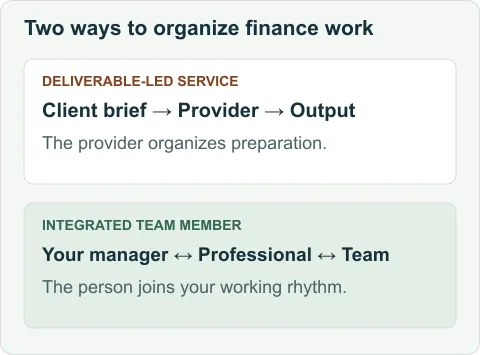
With provider-led delivery, you agree a service or output and the provider organizes its delivery. With an integrated team member, your manager directs the professional and the person works inside your business. Either arrangement can have clear deliverables, recurring work and a long-term relationship.
Nexteam’s model discussed here is the integrated professional: someone who joins your systems, meetings and working relationships like another colleague on-site or remotely in the US.
Two models, two working relationships
| Provider-led delivery | Integrated team member |
|---|---|
| Scope: an output or process, service boundaries and acceptance criteria. | Scope: a role, capacity, responsibilities and review expectations. |
| Direction: the provider organizes delivery under the service agreement. | Direction: your manager sets priorities and works directly with the professional. |
| Changes: revisions and new requests follow the agreed scope-change process. | Changes: your manager reprioritizes within the role and available capacity. |
| Context: you supply the information needed for the agreed output. | Context: the person learns through colleagues, business routines and recurring work. |
| Your role: timely inputs, business decisions and the approvals retained in the agreement. | Your role: management, business context, access and the approvals retained by your team. |
Swipe horizontally to see all columns.
Provider-led delivery can be transparent and collaborative; it need not be a black box. An embedded professional can also work against clear deliverables. The distinction is who manages the delivery process—not whether the work has a deadline.
Start with the gap in your team
Capacity is missing
Your controller knows what needs doing and can direct and review it, but preparation keeps slipping. An embedded accountant can take ownership of a defined workstream and its follow-through.
Delivery management is missing
You want an external team to organize an agreed process. Ask for a named service lead, review arrangements, response expectations and a clear route for exceptions.
Leadership is missing
Nobody owns the close calendar, accounting decisions or cross-team dependencies. Adding a junior preparer alone leaves that gap intact. Assess an experienced senior accountant, controller or a service with that responsibility explicitly included.
Follow the difference through one close
| Provider-led preparation | Embedded accountant |
|---|---|
| Start: client supplies the agreed files; provider checks them against the service scope. | Start: accountant joins close planning and coordinates inputs with colleagues. |
| Unexplained balance: provider investigates or escalates through the agreed exception process. | Unexplained balance: accountant investigates with the relevant team and brings the decision to the reviewer. |
| New entity: parties agree the effect on scope, timing and charges. | New entity: manager reviews capacity, experience and priorities before expanding the role. |
| Review: provider submits the agreed output for acceptance. | Review: accountant brings supported schedules and unresolved questions to the designated reviewer. |
Swipe horizontally to see all columns.
These are example arrangements; the actual scope determines who investigates, reviews and resolves exceptions. In either model, identify who can approve accounting judgments, release payments and sign off reporting.
One missing input: test the arrangement before hiring
The situation
The reconciliation is due tomorrow. A source report is incomplete and operations has not responded. Ask the provider or candidate to walk through what happens next.
If you buy a managed service
Who owns chasing the input? Who tells your controller what is blocked? Can the service lead change the delivery sequence? Agree those actions and escalation points in the scope.
If you hire an embedded accountant
Can the person contact operations directly, explain the impact and propose a next step? Give them the access and relationships to do so. Your manager resolves competing business priorities.
A useful answer names an owner, an action and a decision deadline. “We communicate proactively” is not enough to establish how the work will move.
Make integration work in practice
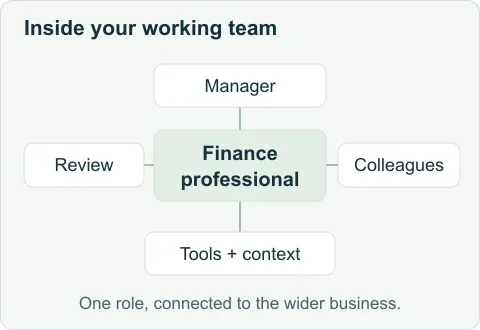
Give the person a manager
Name who sets priorities, provides context and resolves competing requests. A recruiter or staffing contact does not replace that business owner.
Connect the person to the team
Provide appropriate access to systems, working documents and Slack or Microsoft Teams. Include the relevant colleagues and project discussions.
Create a predictable meeting rhythm
Hold a weekly 30–60-minute one-to-one with an agenda from both sides, plus a relevant weekly team or project meeting. Add close-period checkpoints when the work requires them.
Expand complete responsibilities
Begin with a well-defined assignment, review a full cycle and gradually widen ownership. Use a quarterly stop/start/continue discussion to improve the arrangement.
The professional owns preparation, self-checks, follow-through and early escalation. Your manager supplies decisions and context that only the business can provide. Use the meeting rhythm guide and 30–60–90-day plan to make this concrete.
Define “ready for review” before the first cycle
| Work | What the reviewer should receive |
|---|---|
| Account schedule | Balance tied to the ledger, supporting detail, explained differences and unresolved items with an owner. |
| Management reporting | Agreed KPI definitions, figures tied to sources and commentary separating known drivers from questions. |
| Financial model | Identified inputs, assumptions, checks, scenarios and an explanation of how the next owner updates it. |
Swipe horizontally to see all columns.
Use the same acceptance standard whichever model you choose. Then specify who corrects an error, who answers a business question and what counts as additional scope. That avoids discovering after delivery that your team still has to rebuild the work.
Do the labels change who manages the work?
Freelance or fractional
These terms can describe a flexible professional or a portion of recurring capacity. They do not tell you who supervises delivery or whether the person can cover urgent requests.
Nearshore or offshore
These describe geography relative to the buyer. Agree the actual working hours and handoffs; location alone does not establish ownership or service quality.
Outsourced accounting staff
Ask whether you are getting a person you direct or a process the provider manages. Put the answer, including review responsibilities, in the brief and agreement.
A hybrid arrangement needs one owner for the handoff
You can keep a delivery center and add a senior accountant or controller inside your team. For example, the center prepares agreed schedules; the embedded professional coordinates missing inputs, reviews exceptions and brings decisions to your finance lead.
Before adding another person, settle three points: what arrives from the center, who accepts or returns it, and who owns unresolved items. Give the embedded professional sufficient capacity and authority to coordinate the work. Otherwise, the new hire becomes a messenger between teams.
The transition guide covers when to add dedicated capacity; the hybrid finance team guide explains the division of work.
Put the working relationship in the brief
Complete this sentence before comparing proposals:
We need [person / provider] to own [responsibility]. [Name or role] sets priorities, [name or role] reviews the work, and [name or role] resolves blocked inputs. Work is ready when [acceptance criteria] are met. Changes beyond [capacity or scope] require agreement.
For integrated support, compare staff accountant, senior accountant, controller and financial analyst responsibilities. The dedicated and flexible staffing options explain the engagement choices.
Questions to settle before you start
Can outsourced accounting include an embedded accountant?
Yes. Providers use outsourcing for several arrangements. Ask who manages the professional, who reviews the work and what the provider is responsible for under the agreement.
Do we need time to manage an embedded professional?
Yes. Allow time for onboarding, a weekly one-to-one, relevant team meetings and review. The person should become more independent as they learn the business, while your manager retains responsibility for priorities and business decisions.
Can we keep a delivery center and add a controller?
Potentially. Specify what the center prepares, what the controller reviews and coordinates, and who owns the final decisions. A controller cannot solve an unclear handoff without access, authority and a defined scope.
Embedded finance talent
Add a professional who works inside your team
Share the responsibility, systems and working hours you need covered. We’ll review the brief and follow up about suitable support.